
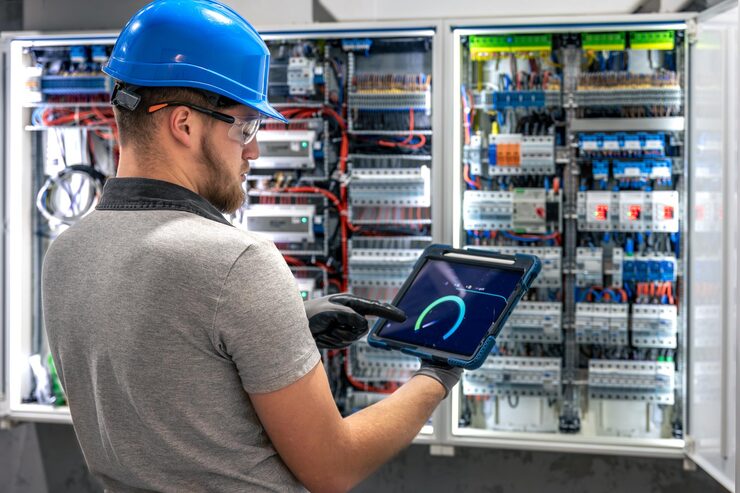
Every conversation about power infrastructure in commercial and tribal facilities eventually comes back to the same foundational element: electrical distribution. How power enters the building, how it flows to different systems and areas, and how the distribution system protects equipment and people from faults — these decisions determine the safety, reliability, and operational capability of the entire facility. Getting electrical distribution right is not just an engineering checkbox. It is the infrastructure decision that everything else depends on.
What Modern Commercial Electrical Distribution Actually Involves
Commercial and industrial electrical distribution encompasses more than a main breaker and a few panels. In facilities of any significant size, the distribution system includes a service entrance section that receives utility power, main distribution equipment that manages primary fault protection and metering, feeder circuits that carry power to subdistribution panels throughout the building, and branch circuit panels that serve individual loads. Each of these elements must be properly rated, coordinated, and maintained.
For tribal governments, casinos, healthcare facilities, and manufacturing plants, the distribution design must also accommodate life-safety systems, emergency power integration, and often specialized loads like medical equipment, gaming systems, or industrial machinery. These requirements go beyond standard commercial building codes and into territory where specification-grade equipment and technical expertise become genuinely important.
Why Distribution System Design Affects Long-Term Facility Operations
A well-designed electrical distribution system provides:
- Operational flexibility: Ability to isolate sections for maintenance without shutting down the entire facility
- Fault containment: Protection coordination that limits the impact of electrical faults to the smallest possible area
- Future capacity: Adequate physical space and electrical capacity for future load additions
- Safety for maintenance personnel: Arc flash analysis and mitigation features that protect workers
- Compatibility with backup power: Transfer switch integration that functions reliably when grid power fails
The Connection Between Electrical Distribution and Backup Power Solutions
Electrical distribution infrastructure and backup power systems are deeply interconnected. The distribution design determines which loads are on the essential circuit that backup power serves, how quickly the transfer switch can safely transition the facility from grid to backup power, and whether the distribution system’s protection coordination allows backup power to function without nuisance tripping during the transition.
Facilities that plan their backup power solutions in isolation from their distribution system design frequently encounter integration problems that are expensive to resolve after installation. A generator that is correctly sized for the facility load can still deliver poor performance if the transfer switch is incompatible with the distribution equipment or if protection settings were never coordinated to account for backup power operation.
Planning Electrical Distribution and Backup Power Together
The most effective approach integrates both systems in the planning phase:
- Define essential load requirements: Which systems must remain powered during an outage and for how long
- Design the distribution system with essential and non-essential circuit separation from the beginning
- Size and specify the backup power system based on the defined essential load
- Specify the automatic transfer switch to be compatible with both the generator and the distribution system
- Coordinate all protection settings across the distribution system with backup power operation in mind
Catawba Power and Lighting as a Distribution and Power Partner

Catawba Power and Lighting sources commercial-grade switchgear and electrical distribution equipment for new construction, facility expansions, and infrastructure upgrades, working with tribal governments, commercial developers, healthcare facilities, and manufacturing operations. The company’s approach starts with understanding project requirements — from specification through delivery — rather than simply fulfilling purchase orders.
As a Native American-owned distribution partner, Catawba helps clients meet supplier diversity goals while accessing specification-grade equipment from leading manufacturers. The company’s direct-ship distribution capability supports projects nationwide, and its infrastructure-level expertise means technical guidance is available alongside product access throughout the project lifecycle.
Conclusion
Electrical distribution is the infrastructure that all other building systems depend on, and its design and quality directly determine the reliability of backup power solutions and every other system connected to it. Investing in a properly specified distribution system, sourced through a knowledgeable Native-owned partner like Catawba Power and Lighting, is the foundation of any serious commercial or tribal infrastructure project.